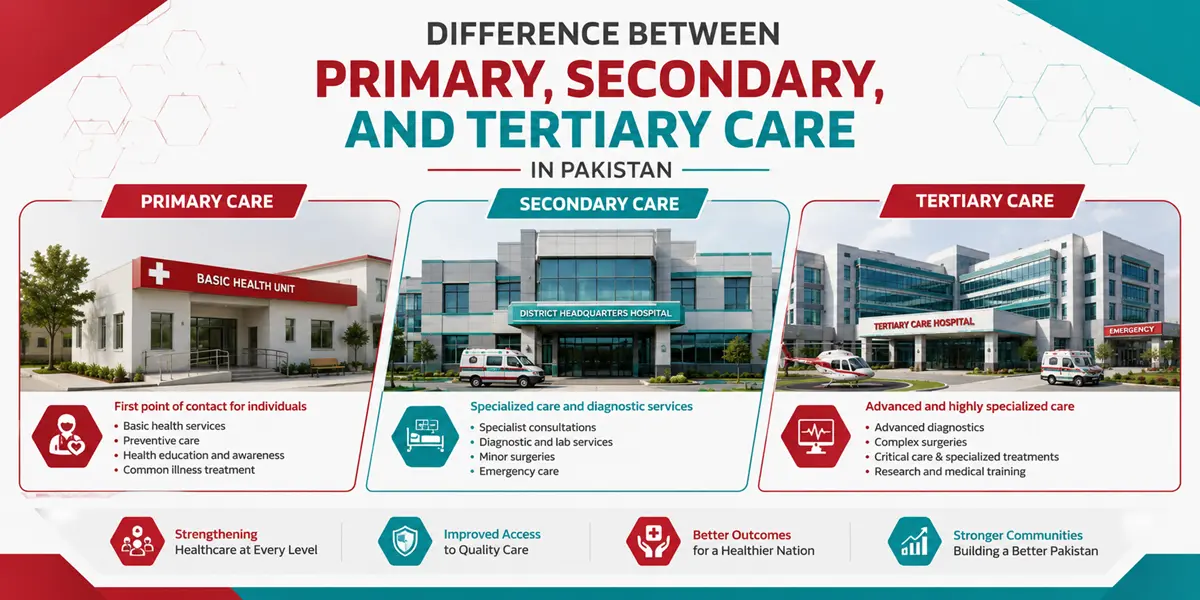
If you have ever been referred from a local clinic to a district hospital and then again to a teaching hospital, you have personally experienced Pakistan’s three-tier healthcare system in action. These three tiers — primary, secondary, and tertiary care — are not just administrative labels. They define what services a facility must provide, what infrastructure it must have, what equipment it must install, and how it must be engineered.
For hospital developers, healthcare administrators, and medical facility planners in Pakistan, understanding these levels is the first step in any new hospital project. The level of care a facility intends to deliver determines everything from floor area and zoning to the type of operation theaters, medical gas systems, and HVAC infrastructure required.
This guide explains each level clearly, maps it to Pakistan’s real-world facility types, and outlines the engineering implications of building at each tier.
- The Three-Tier Healthcare System in Pakistan
- Primary Care: The First Line of Contact
- Secondary Care: Specialist and Inpatient Services
- Tertiary Care: Highly Specialized, Referral-Based Services
- Side-by-Side Comparison: Primary vs Secondary vs Tertiary Care
- Why Infrastructure Determines the Level of Care a Facility Can Deliver
- How ALCON Technologies Supports Every Level of Healthcare Infrastructure
- Frequently Asked Questions
The Three-Tier Healthcare System in Pakistan
Pakistan follows a three-tier public healthcare delivery model, a structure that has been in place since partition and is based broadly on the British Beveridge model. The three levels are:
- Primary care — first contact, preventive, and basic curative care
- Secondary care — specialist and inpatient services at the district level
- Tertiary care — advanced, highly specialized care at major teaching hospitals
Each level serves a progressively smaller but more complex patient population, and each has a defined referral pathway feeding into the next.
Primary Care: The First Line of Contact
What Is Primary Care?
Primary care is the first point of contact between a patient and the healthcare system. It is community-level care focused on prevention, health promotion, early diagnosis, and treatment of common illnesses. In Pakistan, primary care facilities are intentionally distributed across towns and rural areas to be accessible to the general population without requiring referral.
Primary Care Facilities in Pakistan
In Pakistan’s public sector, primary care is delivered through:
- Basic Health Units (BHUs) — the most basic facility type, typically serving a population of 5,000 to 10,000 people in a single union council. A BHU provides outpatient consultations, immunization, maternal and child health services, and basic medicines. Only 15.4% of Pakistan’s population has access to a BHU within their community, a significant gap that drives over-utilization of secondary and tertiary facilities.
- Rural Health Centers (RHCs) — slightly larger than BHUs, serving a population of roughly 25,000 to 50,000 across several union councils. RHCs provide basic inpatient care (usually 10 to 20 beds), minor surgical procedures, basic diagnostics (X-ray, blood and urine examination), and maternity services.
In the private sector, the equivalent of primary care is provided by general practitioners (GPs), family clinics, polyclinics, and small private maternity homes.
What Services Primary Care Covers
Primary care focuses on:
- Preventive care: immunization (EPI program), antenatal care, family planning
- Management of common conditions: fever, diarrhea, respiratory infections, hypertension, diabetes
- Basic diagnostics: malaria parasite, routine blood count, urine examination, basic X-ray
- Maternal and child health
- Health education and community outreach through Lady Health Workers (LHWs)
Infrastructure Requirements at the Primary Level
Primary care facilities are modest in engineering terms, but they still require properly planned clinical spaces. A well-functioning BHU or RHC needs:
- Clean and dirty utility room separation
- Proper waste management for sharps and biohazard materials
- Adequate natural ventilation or basic mechanical ventilation
- Clean water and reliable power supply for refrigeration (vaccines)
- Basic examination rooms with patient privacy
These facilities do not typically require modular operation theaters, centralized medical gas pipelines, or hospital-grade HVAC systems — those requirements begin at the secondary level.
Secondary Care: Specialist and Inpatient Services
What Is Secondary Care?
Secondary care is the intermediate level of the healthcare system, focused on specialist consultations, investigations, and inpatient treatment for conditions that cannot be managed at the primary level. A patient typically reaches secondary care through a referral from a primary care provider, although in Pakistan the referral system is frequently bypassed and patients often present directly to DHQs and THQs.
Secondary care is episodic in nature — a patient comes in for a specific condition, receives specialist treatment, and is either discharged or referred further.
Secondary Care Facilities in Pakistan
Pakistan’s secondary care tier consists of:
- Tehsil Headquarters Hospitals (THQs) — located at the tehsil level, serving a population of 300,000 to 500,000. THQs typically have 40 to 120 beds and are expected to provide outpatient specialist care, basic inpatient services, emergency care, maternity services, and basic surgical procedures. They should be equipped with at least six to nine medical specialties.
- District Headquarters Hospitals (DHQs) — larger facilities located at the district headquarters, serving a population of 1 to 3 million depending on the district. DHQs have 100 to 600+ beds and provide a broader range of inpatient services, advanced diagnostics, specialist care, and emergency services including EmONC (Emergency Obstetric and Newborn Care). DHQs also serve as referral destinations for patients from BHUs, RHCs, and THQs.
What Services Secondary Care Covers
Secondary care includes:
- General medicine and surgery
- Gynecology and obstetrics
- Pediatrics
- Orthopedics and trauma
- ENT, ophthalmology
- Basic psychiatry
- Emergency and trauma management
- Inpatient diagnostics: ultrasound, CT scan (at larger DHQs), pathology lab
- Basic surgical procedures including cesarean sections and appendectomies
Infrastructure Requirements at the Secondary Level
This is where hospital engineering requirements begin in earnest. A functional secondary care hospital — whether a THQ, DHQ, or equivalent private facility — requires:
Operation Theaters: Secondary care hospitals must have at least one to three functional operation theaters capable of handling general surgery, orthopedics, and obstetric emergencies. At this level, a modular operation theater is strongly recommended over a conventional tiled OT. Modular OTs use laminar airflow systems, HEPA filtration, and antibacterial prefabricated panels to maintain the sterile environment required by WHO and ISO 14644 standards — dramatically reducing the risk of surgical site infections.
Medical Gas Pipeline Systems: Any hospital performing surgery or managing critical patients needs a centralized medical gas pipeline system (MGPS). Oxygen, medical air, and vacuum must be continuously available at every operating table, ICU bed, and recovery room outlet. Relying on cylinder-based delivery at a 200-bed DHQ is operationally risky and clinically dangerous.
HVAC Systems: Secondary care hospitals need dedicated hospital HVAC systems for operation theaters, ICUs, and high-dependency units. Each OT should have a separate dedicated HVAC unit — sharing a single unit across multiple theaters is a cross-contamination risk. ASHRAE 170 recommends a minimum of 15 air changes per hour (ACPH) in operating rooms, with the air positively pressurized relative to surrounding corridors.
CSSD: Every hospital performing surgical procedures must have a Central Sterile Supply Department. Without proper sterilization infrastructure, instrument reprocessing is inconsistent and infection risk is unacceptably high.
Tertiary Care: Highly Specialized, Referral-Based Services
What Is Tertiary Care?
Tertiary care is the most advanced level of the hospital system. It provides highly specialized medical and surgical services, usually to patients referred from secondary care facilities whose conditions cannot be managed at the district level. Tertiary care is typically delivered on an inpatient basis and includes complex surgical procedures, advanced diagnostics, and management of rare or severe conditions.
In Pakistan, tertiary care is concentrated in major cities — Lahore, Karachi, Islamabad, Peshawar, Quetta — and is delivered primarily through teaching hospitals attached to medical colleges.
Tertiary Care Facilities in Pakistan
- Teaching Hospitals — affiliated with medical colleges and equipped with the full complement of specialties. They serve as training centers for doctors, nurses, and allied health professionals and conduct clinical research. Examples include Services Hospital Lahore, Jinnah Hospital Lahore, Nishtar Hospital Multan, Lady Reading Hospital Peshawar, Civil Hospital Karachi, PIMS Islamabad, HMC Peshawar, and CMH Lahore (a Level 5 tertiary care teaching hospital with over 1,100 beds).
- Specialized Tertiary Centers — standalone facilities focused on a specific disease category, such as the Institute of Cardiology (Lahore, Rawalpindi, Wazirabad), cancer centers, neurology institutes, and eye hospitals.
- Large Private Tertiary Hospitals — private hospitals such as Shaukat Khanum Memorial Cancer Hospital, Aga Khan University Hospital, and Doctors Hospital (Lahore) function at the tertiary level, offering advanced diagnostics, subspecialty surgery, and critical care.
What Services Tertiary Care Covers
Tertiary care covers the full clinical spectrum including:
- Cardiothoracic surgery and interventional cardiology
- Neurosurgery and neuroradiology
- Organ transplantation (kidney, liver, bone marrow)
- Oncology (chemotherapy, radiotherapy, surgical oncology)
- Neonatal ICU (NICU) and pediatric ICU (PICU)
- Advanced trauma and burn management
- Subspecialty diagnostics: MRI, PET-CT, advanced laboratory medicine
- Robotic and laparoscopic surgery
- Multi-disciplinary team management of complex cases
Infrastructure Requirements at the Tertiary Level
Tertiary hospitals are the most demanding from an engineering perspective. The sheer scale, the complexity of procedures, and the 24/7 operational requirement make infrastructure reliability non-negotiable.
Multiple Modular Operation Theaters: A major teaching hospital may have 10 to 30+ operation theaters across general surgery, cardiac surgery, neurosurgery, orthopedics, and obstetrics blocks. Each theater requires its own dedicated laminar airflow HVAC unit, ISO Class 5 or Class 6 cleanroom classification depending on procedure type, and hermetically sealed modular walls. The hospital design and planning for a tertiary OT block is a specialized discipline that must integrate clinical workflow, infection control zones, CSSD placement, and equipment access into a coherent plan.
Centralized MGPS with Redundancy: At the tertiary level, a medical gas pipeline failure during a cardiac or neurosurgery procedure can be fatal. Tertiary hospitals require automatic electronic switchover manifolds, backup cylinder banks, area alarm panels in every zone, and regular commissioning and validation to HTM 02-01 standards. Oxygen consumption alone at a 500-bed teaching hospital with an active ICU can exceed thousands of liters per hour.
Hospital-Grade HVAC with BMS Integration: Tertiary hospitals require a multi-zone HVAC system managed through a Building Management System (BMS). Different areas require different air quality and pressure classifications — a positive-pressure bone marrow transplant unit, a negative-pressure isolation room for infectious disease, a neutral-pressure general ward, and an ultra-clean ISO Class 5 laminar flow theater for implant surgery all coexist in the same building and require independent air handling. ASHRAE 170 and HTMF guidelines govern the specific requirements for each area type.
Full CSSD with Multiple Sterilization Lines: A tertiary hospital’s CSSD must process thousands of instrument sets daily. This requires multiple pre-vacuum steam sterilizers (autoclaves), washer disinfectors for every instrument type, dedicated TSSU (Theater Sterile Supply Units) adjacent to the OT block, ETO or plasma sterilization for heat-sensitive devices, and a HEPA-filtered sterile storage area.
Side-by-Side Comparison: Primary vs Secondary vs Tertiary Care
| Feature | Primary Care | Secondary Care | Tertiary Care |
| Facility type | BHU, RHC, GP clinic | THQ, DHQ, district hospital | Teaching hospital, specialized center |
| Patient entry | Walk-in, community | Walk-in or referred | Referred from secondary |
| Bed capacity | 0–20 | 40–600 | 300–2000+ |
| Surgical capability | None / minor | General surgery, C-section | All subspecialties |
| ICU | No | Basic (at DHQ level) | Full ICU, NICU, PICU, CCU |
| Specialist coverage | GP only | 6–9 specialties | All specialties + subspecialties |
| Diagnostics | Basic blood/urine, X-ray | CT, ultrasound, pathology | MRI, PET-CT, molecular diagnostics |
| HVAC requirement | Basic ventilation | Dedicated OT HVAC | Multi-zone BMS-controlled HVAC |
| MGPS | Not required | Essential | Fully redundant centralized MGPS |
| Modular OT | Not required | Recommended | Mandatory, multiple theaters |
| CSSD | Not required | Essential | Full multi-line CSSD + TSSU |
| Teaching function | No | Partial (at DHQ) | Yes — full training center |
Why Infrastructure Determines the Level of Care a Facility Can Deliver
A hospital’s level of care is not determined solely by the number of beds or the qualifications of its doctors. In practice, the physical infrastructure — the operation theaters, the air quality systems, the medical gas supply, the sterilization capability — defines the upper limit of what can safely be done inside that building.
A DHQ with a conventional tiled OT, cylinder-based oxygen, and no CSSD cannot safely perform elective orthopedic or cardiac surgery, regardless of the surgeon’s skill. A teaching hospital with unreliable HVAC in its bone marrow transplant unit puts immunocompromised patients at direct risk of fatal fungal infections.
This is why the engineering and infrastructure planning for a hospital must begin from a clear understanding of what level of care the facility intends to deliver — and then be specified and executed accordingly.
Pakistan’s tertiary hospital system received approximately 60% of public health infrastructure investment in the 2019–2021 period, while primary health care received less than 40%. Yet the referral system that is supposed to filter patients appropriately is consistently bypassed, leaving secondary and tertiary facilities overcrowded while primary facilities remain underutilized. The solution requires not just policy reform but properly designed and equipped facilities at every level that genuinely earn patient trust.
How ALCON Technologies Supports Every Level of Healthcare Infrastructure
ALCON Technologies delivers turnkey hospital engineering solutions for secondary and tertiary care facilities across Pakistan. Our work covers the full range of systems that define what level of care a facility can deliver:
- Modular Operation Theaters — ISO-compliant modular OTs for THQs, DHQs, teaching hospitals, and private surgical centers. From single-theater installations to 20-theater OT blocks, designed with laminar airflow, HEPA filtration, and hermetically sealed surfaces.
- Medical Gas Pipeline Systems — HTM 02-01-compliant MGPS for oxygen, nitrous oxide, medical air, and vacuum. Complete with manifolds, AVSUs, BHUs, area alarms, and full commissioning.
- Hospital HVAC Systems — dedicated OT HVAC units, AHUs, VRF systems, chillers, and multi-stage HEPA filtration. Designed to ASHRAE 170 and ISO standards with BMS integration for large facilities.
- CSSD and Sterilization Equipment — complete CSSD setup including pre-vacuum autoclaves, washer disinfectors, ultrasonic cleaners, pass-through cabinets, and sterile storage.
- Hospital Design and Plan Consultancy — clinical workflow analysis, zoning, room data sheets, and engineering coordination from feasibility through commissioning.
Whether you are upgrading a district hospital from secondary to tertiary capacity, building a new private hospital from the ground up, or establishing a specialized surgical center, ALCON provides a single turnkey partner for all critical hospital systems.
Frequently Asked Questions
What is the difference between a DHQ and a teaching hospital in Pakistan?
A DHQ (District Headquarters Hospital) is a secondary care facility providing specialist and inpatient services to the district population. A teaching hospital is a tertiary care institution affiliated with a medical college, offering the full range of medical and surgical subspecialties and serving as a training center for healthcare professionals. Teaching hospitals typically have far greater bed capacity, more specialized services, and substantially more complex infrastructure requirements.
Can a private hospital be a tertiary care hospital in Pakistan?
Yes. Private hospitals such as Aga Khan University Hospital, Shaukat Khanum Memorial Cancer Hospital, and Doctors Hospital function at the tertiary care level. They offer advanced subspecialty services, complex surgery, and research activities comparable to public teaching hospitals.
What is the role of BHUs and RHCs in Pakistan’s health system?
BHUs and RHCs are the primary care backbone of Pakistan’s public health system. They are supposed to serve as the first point of contact for community health needs, managing common illnesses, providing immunizations, and referring cases upward when needed. In practice, they are significantly underutilized due to staffing shortages and infrastructure deficiencies.
Why do patients bypass primary and secondary care facilities in Pakistan?
Pakistan’s referral system is largely informal and non-enforced. Patients often lack trust in lower-level facilities due to inadequate staffing, equipment shortages, and infrastructure gaps. As a result, tertiary facilities in major cities are chronically overcrowded while primary care facilities are underutilized.
What infrastructure does a secondary care hospital absolutely need?
At a minimum, a functioning secondary care hospital needs at least one modular operation theater with laminar airflow HVAC, a centralized medical gas pipeline system for oxygen and vacuum, a CSSD for instrument sterilization, and adequate diagnostic equipment. Without these, the facility cannot safely perform the surgical and emergency procedures that define secondary care.
What is quaternary care?
Some health systems recognize a fourth level — quaternary care — for experimental treatments, highly rare procedures, and cutting-edge interventions not available even at most tertiary centers. In Pakistan, this level of service is available at a very small number of institutions and is not yet formally defined in the national health system structure.
Conclusion
Pakistan’s healthcare system is built on three levels — primary, secondary, and tertiary — each serving a distinct role in the continuum of patient care. Primary care provides the community-level foundation. Secondary care handles specialist and inpatient needs at the district level. Tertiary care delivers advanced, subspecialty services at major teaching hospitals and specialized centers.
For hospital developers and planners, the most important takeaway is that the engineering infrastructure of a facility must match the level of care it intends to provide. A secondary care facility needs modular OTs, MGPS, and CSSD. A tertiary facility needs all of those at scale — plus redundancy, multi-zone HVAC, advanced sterilization capacity, and integrated building management.
Getting the infrastructure right is not optional. It is what separates a facility that can deliver on its clinical promise from one that cannot.
Ready to plan or upgrade your hospital’s infrastructure? Contact ALCON Technologies for a free consultation on turnkey hospital engineering solutions tailored to your facility’s level of care.
ALCON Technologies is a leading healthcare infrastructure company in Pakistan, delivering turnkey hospital engineering solutions including modular operation theaters, medical gas pipeline systems, hospital HVAC, CSSD, and hospital design consultancy. Serving healthcare facilities nationwide.